
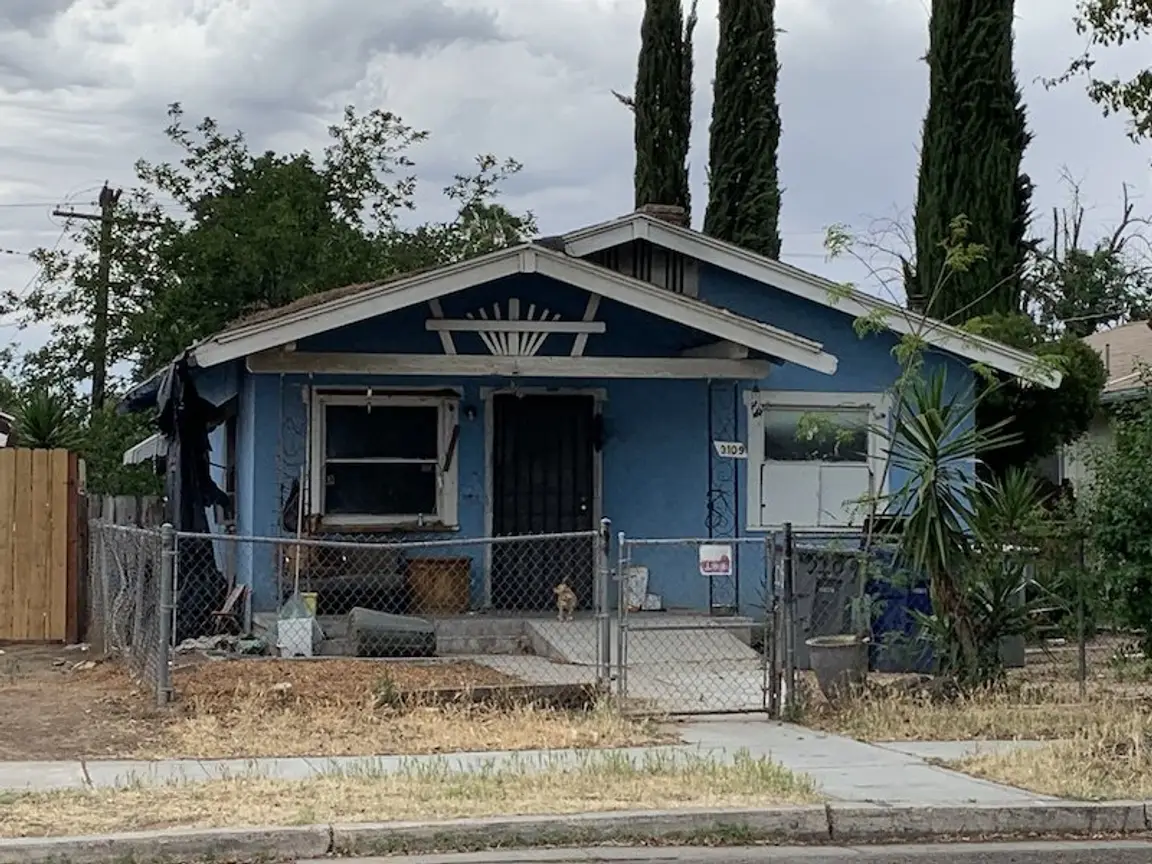
A cash offer on a house is not a mood, a percentage of your Zillow estimate, or a number somebody made up on the drive over. It is one subtraction: what the house is worth once it is fixed up, minus the cost of the repairs, minus the cost of owning and closing on it twice, minus the buyer’s profit margin. If a cash buyer will not walk you through those four numbers line by line, that is the real problem — not the fact that the offer landed below a retail listing price.
Here is the current backdrop, and it matters because every one of those four numbers is local. According to Redfin’s Fresno market data for the three months ending July 2026, the median sale price in Fresno, California was $407,706, down 1.8% year over year, with homes taking 47 days to sell versus 30 days a year earlier and a median of $250 per square foot. Over the same month, Redfin’s statewide California figures show the median sale price rose 1.3% to $759,766 with median days on market at 43, four days faster than last year.
Why does a Fresno cash offer look different from the California headline?
Because Fresno and California are moving in opposite directions right now. In July 2026, Redfin recorded a median sale price of $407,706 in Fresno, California, down 1.8% from a year earlier, while the statewide California median rose 1.3% to $759,766. Statewide, homes are selling faster than last year. In Fresno, they are taking 17 days longer than they did in 2025.
That gap is not trivia. An offer is built on sold comparables within about a mile of your house in the last three to six months — not on a state median, not on a national forecast, and not on what your neighbor listed for and never got. When local prices soften and days on market stretch, the after-repair value that anchors the whole calculation moves down and the carrying-cost estimate moves up. Both push the offer lower, and neither has anything to do with anyone’s opinion of your house.
How is a cash offer on a house actually calculated?
Four inputs, in this order. Any legitimate cash buyer in Fresno should be able to hand you all four in writing:
- After-repair value (ARV). What the house sells for on the open market once it is fully repaired, based on recent sold comps — similar square footage, similar age, same neighborhood. Fresno’s current $250 median price per square foot is a sanity check on this number, not a substitute for it.
- Repair cost. Everything a retail buyer’s lender and appraiser will require, plus everything a retail buyer will demand after inspection. Roof, foundation, electrical, HVAC, permits on unpermitted work.
- Holding and transaction cost. The buyer pays taxes, insurance, utilities and financing on the property for the whole rehab-and-resale window, then pays closing costs and an agent commission on the way back out. In a 47-day market that window is longer than it was a year ago.
- Margin. The buyer’s profit, and the buffer that absorbs the repair that was not visible from the driveway. This is the only genuinely negotiable input, and it is the one most buyers will not show you.
If a buyer quotes you a flat “percentage of value” with no repair scope and no comps attached, they have skipped steps one through three. Ask for the comps. A buyer who has actually done the work will send them.
Are cash buyers lowballing, or is the retail price just not what you keep?
The data-backed view: a cash number and a list price are not the same unit of measurement, so comparing them directly is a category error. A list price is a gross number before commission, before lender-required repairs, and before months of carrying cost. A cash number is close to what actually lands in your account. Compare gross to gross and the cash offer looks like a big discount. Compare net to net and the gap narrows sharply — sometimes to nothing, sometimes it reverses.
The contrarian view, and where it is right: plenty of cash buyers are lowballing, and the pattern is recognizable. They quote before seeing the house, they refuse to itemize repairs, they assign the contract and vanish, or they renegotiate downward a week before closing. The reason this criticism keeps landing is that the industry has no obligation to show its arithmetic, so a fair offer and a predatory one look identical from the outside. The fix is not to distrust every cash offer — it is to make every cash buyer show you all four inputs, then compare their net to your retail net.
What breaks the retail path for a Fresno house that needs work?
The specific disqualifier is financing. Roughly speaking, a mortgage lender will not fund a house with an active safety or habitability defect — a failed roof, a red-tagged electrical panel, missing flooring or fixtures, structural movement. The appraiser calls it out, underwriting requires the repair before funding, and the seller is asked to pay for it out of pocket before escrow closes. If you cannot fund those repairs up front, the financed buyer pool is not available to you at any price, and the only buyers left are the ones paying cash anyway.
So the honest comparison is net to net. Here is a worked example, and every number in it is an illustrative input stated in the sentence — it is not a result Big Buys Houses is claiming, and your numbers will differ:
- Retail path on a Fresno house with a $400,000 after-repair value that needs $45,000 of lender-required work: $400,000 sale price, minus $45,000 repairs paid up front, minus a 5% agent commission of $20,000, minus about four months of carrying cost at $2,000 per month ($8,000 for mortgage, taxes, insurance and utilities across the repair window plus Fresno’s current 47-day marketing time and escrow). Net: roughly $327,000 — before any inspection concession or fall-through.
- Cash path on the same house sold as-is: a $305,000 gross offer, no commission, no repairs, no carrying cost, no concessions. Net: $305,000, in weeks rather than months.
In that example, retail wins by about $22,000, and any honest buyer should tell you so. If you have the $45,000 sitting in savings, the stomach for a four-month project and no deadline pressing on you, list the house. You will keep more money. That is not a concession — it is the whole point of running the math instead of arguing about percentages.
Now change one input. If the $45,000 is not available, the retail path in that example does not net $327,000 — it does not exist, because the house cannot be financed as-is. At that point the comparison is not $327,000 versus $305,000. It is $305,000 versus a listing that sits, collects price cuts, and eventually sells to an as-is buyer anyway after you have paid several more months of carrying cost. You can get a cash offer on your Fresno house and use it purely as a floor to measure the retail path against, which is the most useful thing an offer does.
Should you list the house or take the cash offer?
If you can fund the repairs and you are not on a clock: list it. Hire an agent, do the lender-required work, price to Fresno’s current 47-day reality rather than to last year’s 30-day market, and take the higher net. Use a cash offer only as a benchmark. This is true whether the house is in Fresno proper or you are looking at selling a house fast in Clovis or elsewhere in the Central Valley.
If the repairs are unfundable, the timeline is fixed, or the house cannot be financed as-is: the retail number on the listing sheet is not a number you can actually reach, and comparing yourself to it will cost you months. Get the cash number, make the buyer itemize all four inputs, and decide on net proceeds and certainty. More on how this works without an agent in our guide to cash home buyers and selling without an agent.
This is general information, not legal or financial advice.
Cash offer questions Fresno sellers actually ask
Why is a cash offer lower than my Zillow estimate?
A Zillow estimate is an automated guess at retail value for a house in average condition, and it does not see your roof, your foundation, or your kitchen. A cash offer subtracts repairs, several months of holding and closing cost, and a profit margin from that retail value. The gap between the two is mostly the repair scope, which is why the estimate and the offer can be far apart on a house that needs work and close together on one that does not.
How do cash buyers decide the after-repair value on my street?
From sold comparables — homes of similar size, age and condition that closed within roughly the last three to six months, usually within about a mile. Active listings and pending sales are weak evidence because nobody has paid those prices yet. In Fresno, California the current median is $250 per square foot as of Redfin’s data for the three months ending July 2026, which is a useful cross-check on any ARV you are handed.
Can I ask a cash buyer to show me their numbers?
Yes, and you should. Ask for the comps behind the after-repair value, the itemized repair estimate, the assumed holding period, and the margin. A buyer who has actually inspected and underwritten your house can produce all four in a few minutes. A buyer who cannot is either guessing or planning to renegotiate later.
Does a lower cash offer always mean less money in my pocket?
No — but it often does, and that is worth saying plainly. On a house in good condition with a seller who can wait, listing on the open market usually nets more even after commission. The cash path tends to win only when repairs are unfundable, the property will not qualify for financing, or a hard deadline makes months of market time impossible. Run both nets before deciding.
What do you think?
Have you had a cash offer on a Central Valley house that came with no explanation of how it was built — or one where the math actually held up? Tell us what you were shown, or send us the address and we will walk you through all four inputs on your own house so you have something real to compare your retail net against.
Step 1
TEXT, CALL OR SUBMIT
YOUR INFO

We review the details of your home and set an appointment to speak with you.
Step 2
WE GIVE YOU A
FAIR CASH OFFER

We get a cash offer to you in 24hrs. No Obligation. No Fees. No Commissions
Step 3
CHOOSE YOUR
CLOSING DATE

We can close on your schedule, fast or slow. Sell your house on your terms.